Before departure: buy, rent, reserve
The most important lesson up front: when buying boots, take your operator's advice, not the sports shop's. A store sold me a high-quality expedition boot (La Sportiva Nepal Evo GTX) as altitude-proof – "that's what people wear above 6,000 meters." My operator's answer was unambiguous: very good boots, but not enough for Aconcagua. It has to be true double boots. Asking before buying saved me an expensive mistake.
You don't have to buy the big-ticket items – double boots, parka, expedition sleeping bag, mittens: most operators rent them out, and with mine the rental gear was even included in the package. Important: reserve rental gear about 30 days before departure, or you risk your size being gone. For the sleeping bag, state your height.
On luggage logistics, straight from my questions to the operator: a 100-liter backpack fits inside the 150-liter duffel for the flight; most climbers check one bag and carry the daypack on board. The daypack test: does everything you carry on a climbing day fit – food, bottles, thermos, wind jacket, layers, gloves, goggles, sunscreen? Then it's big enough (my 30 liters worked). And: power banks can only be charged at base camp, not in the high camps – plan capacity accordingly.
And one important qualifier on the big backpack: I needed the 100 liters because I carried my own gear to the high camps – up to 20 kilos per stage. If you book porters from the start, as most people do, you don't need a 100-liter pack: a considerably smaller trekking backpack alongside the daypack is enough.
On the body: the layering principle
- Feet: double boots, crampons, merino socks, two foot warmers
- Hands: thin liner gloves, mittens, hand warmers
- Legs: ski base layer, warm trekking pants, Gore-Tex pants
- Torso: ski base layer, long-sleeve technical shirt, fleece, hardshell, parka – the down jacket as a reserve in the pack
- Head: headlamp, ski goggles, balaclava, two buffs, beanie, earplugs
In the 30-liter pack
- One complete emergency blanket, first-aid kit, Imodium, aspirin, electrolytes
- A liter of tea, two liters of water – and half a bottle of Coke: sugar, caffeine, and morale in one bottle
- Snacks, helmet, poles, ice axe
- Phone and Garmin inReach (beyond the park entrance there is no reception)
- Tissues, spare socks to keep the drinks warm, lip balm, sunscreen
For sleeping in the high camps
A sleeping bag rated to minus 20 or 25 degrees Celsius, a pad – and the habit of sleeping with half your equipment: water bottles and electronics go into the bag with you so nothing freezes. Earplugs are not a recommendation but a requirement: at 5,500 meters, the wind on the tent sounds like a freight train.
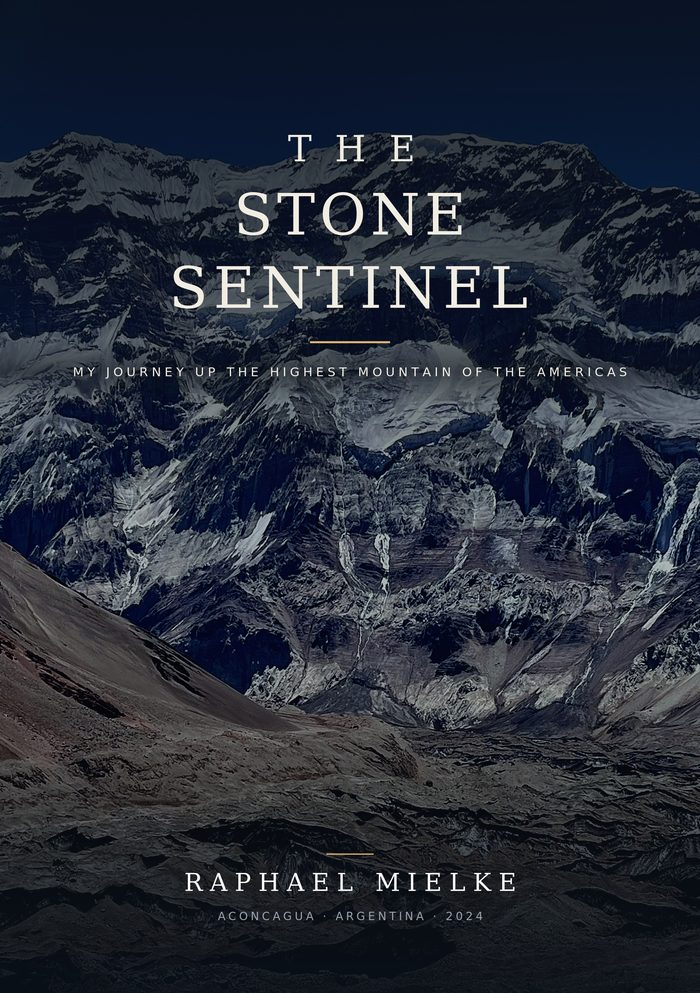
The full story is in the book
“The Stone Sentinel” tells the expedition behind these numbers – three weeks of dust, storm, and thin air.
Get the book on AmazonKeep reading: What does the expedition cost? · Training for Aconcagua · How dangerous is it, really?
← To the full Aconcagua Q&A