What is Aconcagua – and where does the name come from?
At 6,961 meters (22,838 ft), Aconcagua is the highest mountain in the Americas – and the highest mountain in the world outside Asia. It stands in the Argentine Andes, in Mendoza Province, only about 15 kilometers from the Chilean border: the park entrance sits right on the highway between Mendoza (about 180 km) and Santiago de Chile. Via the normal route it is a trekking peak with no technical climbing – which does not make it harmless: altitude, cold, and storm are the real opponents here.
As South America's highest peak it is one of the Seven Summits, the highest mountains of the seven continents – and among them it is number two, behind only Everest:
| Continent | Peak | Height |
|---|---|---|
| Asia | Mount Everest | 8,849 m |
| South America | Aconcagua | 6,961 m |
| North America | Denali | 6,190 m |
| Africa | Kilimanjaro | 5,895 m |
| Europe | Elbrus | 5,642 m |
| Antarctica | Mount Vinson | 4,892 m |
| Australia/Oceania | Carstensz Pyramid (or Mount Kosciuszko) | 4,884 m (2,228 m) |
The name most likely comes from the indigenous languages of the Andes. The best-known reading traces it to the Quechua "Ackon Cahuak": "the Stone Sentinel". That is exactly where my book and its German edition ("Der steinerne Wächter") got their titles. Other interpretations point to Aymara ("white ravine") or Mapudungun – scholars have never fully agreed. But once you have seen the mountain rise above the Horcones Valley, you understand why the sentinel won.
What does an Aconcagua expedition cost?
My guided expedition cost 5,800 € including rental equipment – sleeping bag, parka, double boots, mittens (as of 2024). Add about 650 € for the special insurance covering rescues above 6,000 meters – standard travel health policies usually end there. Flights, hotels, and meals before and after the tour come extra, as does the national park permit.
If you want porters for every stage, hot showers at base camp, or Wi-Fi, you pay hefty surcharges – a hot shower runs about 50 €. In my season that came to 8,000 to 10,000 € all in – since then, permits above all have risen sharply: as of 2026/27, realistically budget €9,000 to €11,000.
Which operator did I climb with – and what do I recommend?
I climbed in January 2024 with Acomara (Aconcagua Expeditions), a local operator from Mendoza – and was happy with them: experienced Argentine guides, their own infrastructure up to the high camps, rental equipment included. As a rule of thumb: local Mendoza operators usually offer the best value for money, while European and US providers offer more full service at a higher price.
The complete market overview – who is currently active, with routes and price levels – is in the article "Which operator for Aconcagua?".
What does the permit cost – and how do you get it?
The permit is set anew every season – and has risen sharply of late. For the 2025/26 season, foreigners officially paid 1,170 USD for the normal route and 1,450 USD for the 360° route, in each case when booking through a registered local operator; without one it is 1,640 and 2,000 USD. In my 2023/24 season it was still 800 USD in high season – nearly a doubling in two years.
You cannot simply buy the permit online: either your operator secures it in the pre-sale, or you handle it in person in Mendoza – a trip to the authorities, payment in pesos, several working days of lead time. The new season's rates usually appear in October/November on aconcagua.mendoza.gov.ar.
How dangerous is it, really?
Honest answer: more dangerous than most vacation destinations, more harmless than its reputation – if you follow the rules. Several thousand people attempt the summit each season; on average two to three die, almost always above 6,000 meters. The vast majority of fatalities trace back to altitude sickness, cardiovascular failure, and exhaustion, not to falls – the normal route has no technical climbing sections.
Translated: the danger is manageable for those who ascend slowly, drink a lot, stay honest about their symptoms, and turn around when in doubt. It can be lethal for those who skip any one of those. And know this, too: above roughly 6,000 meters, every rescue becomes a major operation – at some point the air is too thin even for helicopters.
Do you need climbing experience?
Not for the normal route – but you need confident crampon technique, experience with multi-day tours, storm-proof tent routine, and the ability to go without comfort for weeks. Aconcagua is not a climbing mountain; it is an endurance, logistics, and head mountain.
And one more thing you need: luck. Weather can cross out your entire calculation more thoroughly than any other variable – we witnessed sixteen days without a single summit window ourselves.
How do you train for it (properly)?
The gold standard: at least four to six months of systematic build-up. Two to three endurance sessions a week, one of them long (several hours in zone 2). Add strength training for legs, core, and back – the pack weighs up to 20 kilos on the mountain. The most important building block: hiking uphill with a heavy pack, as often and as realistically as possible, ideally with nights spent at real altitude.
And you should have been to 6,000 meters at least once beforehand – not as an athletic credential, but to know how your own body responds to altitude. I watched people fail on that mountain who were fitter than me. Altitude is a discipline of its own – and to a large degree predisposition.
When is the best time?
The official park season runs from November 1 to April 30; summit climbs effectively happen between mid-November and late February – summer in the Southern Hemisphere. Peak season with the most stable weather (and the priciest permits) is mid-December to late January; I summited in January. Outside the season the mountain is closed, or accessible only with special permits and only for extreme mountaineers.
What is the weather like on Aconcagua?
Aconcagua makes its own weather – and that is its most dangerous tool. In season (November to February) the valleys are hot and dusty, but from the high camps upward, wind and cold rule: on our summit day it was minus 25 °C at the start, with gusts around 60 km/h and up to 80 km/h in the traverse. The infamous Viento Blanco, the white storm, can shut the mountain down completely for days.
The most important number from my season: before our summit window, the mountain had let nobody up for 16 days. That is exactly why buffer days and patience decide summit success – not fitness. Weather forecasts exist for base camp (the guides work with their own), but the only reliable thing on this mountain is that the weather changes faster than the plan.
What is the summit success rate?
The seasonal success rate is roughly 10 to 20 percent – weather is the biggest variable. In our group, six of twelve participants reached the summit, and that already counted as above average. Summit day itself: 15 hours on our feet, starting at 5:00 a.m. at minus 25 degrees Celsius, summit at 2:52 p.m.
Can you climb Aconcagua with supplemental oxygen?
These days, yes – and it is the most striking trend on the mountain. Several operators now run shortened "Rapid" or "Flash" programs: with bottled oxygen from about 5,500 meters, sometimes combined with weeks of hypoxic pre-acclimatization in a tent at home, the expedition shrinks from 18 to 11–14 days. The price: from around 8,500 USD up to nearly €16,000 with the premium providers; renting oxygen for summit day alone runs about €1,700.
The classic way – and the one the vast majority takes – remains climbing without bottled oxygen, with proper acclimatization over two and a half weeks. That was my expedition, too. If you are considering the shortcut, know this: the time saving is real, but the altitude stays the same.
What do you eat and drink on the mountain?
Up to base camp, the catering is astonishingly good: real cooks work in Confluencia and Plaza de Mulas; there are empanadas, burgers, even a barbecue. In the high camps things get simpler: freeze-dried food, soups, tea, plus the snacks you assembled yourself for seven days. Appetite drops rapidly with altitude – eating becomes a discipline.
Drinking matters even more: six to eight liters daily, mostly melted glacier water. On summit day I carried a liter of tea, two liters of water, and half a bottle of Coke – the latter is worth gold on a mountain: sugar, caffeine, and morale in one bottle.
How do you sleep up there?
In short: badly, and that is normal. Altitude massively disrupts the sleep rhythm; add wind, cold, and cramped quarters. At base camp you sleep in communal tents on cots; in the high camps, two to an expedition tent, in bags rated to minus 20 or 25 degrees Celsius.
You sleep with half your equipment: water bottles and electronics go into the sleeping bag with you so nothing freezes. Earplugs are not a recommendation but a requirement – at 5,500 meters, the wind on the tent sounds like a freight train.
What belongs on the summit-day packing list?
On the feet: double boots, crampons, merino socks, two foot warmers. On the hands: thin liner gloves, mittens, hand warmers. On the body: ski base layers, trekking and Gore-Tex pants, technical shirt, fleece, hardshell, parka – the down jacket as a reserve. On the head: headlamp, ski goggles, balaclava, two buffs, beanie, earplugs.
In the 30-liter pack: an emergency blanket, a liter of tea, two liters of water, half a bottle of Coke, snacks, helmet, poles, ice axe, phone, Garmin inReach, first-aid kit. And the trick that proved its worth most: cut up emergency blankets beforehand and use the pieces as extra insulation – in the boots, in the mittens, and wrapped around the water bottles.
The complete packing list – from pre-departure logistics to summit day – is available here as a free PDF and in detail in the packing-list article.
Is there cell reception or internet?
Beyond the park entrance there is no reception. My solution: a Garmin inReach Mini, a satellite communicator the size of a matchbox. Anyone could live-track me via a link, and I could send short daily messages of 120 characters. For the people at home, that daily sign of life is worth more than any souvenir.
Base camp now also sells Wi-Fi packages – expensive, and nobody can guarantee they will actually work on any given day.
How does hygiene work on the mountain?
Accept it before you leave: on the mountain, you make compromises. Hot showers exist only at base camp and only for a surcharge – otherwise it's sponge baths with wet wipes, a handful of snow, or the ice-cold glacial lagoon. You wear the same clothes for days.
In the high camps, everything must come back down – nothing may stay up there and endanger the meltwater that everyone on the mountain drinks from. Most important rule: sanitize your hands, consistently. Gastrointestinal infections end more expeditions than the weather does.
Which mountains should you climb first?
Nobody falls onto a 7,000-meter peak – you work your way up over years. For me, after Huayna Potosí in 2018, it was more than 60 summits and tours in over 16 countries, from Mont Blanc to Kilimanjaro to the Grossglockner, plus high-alpine and glacier tours in the Alps.
The decisive part: at least one 6,000er before Aconcagua – not as a credential, but as the only real test of your own altitude tolerance.
Would you do it again?
Instantly. But differently: with systematic training over months, with the insurance question settled before booking instead of after – and with the promise to open my mouth next time when I am not doing well. Why that matters is what the book is about.
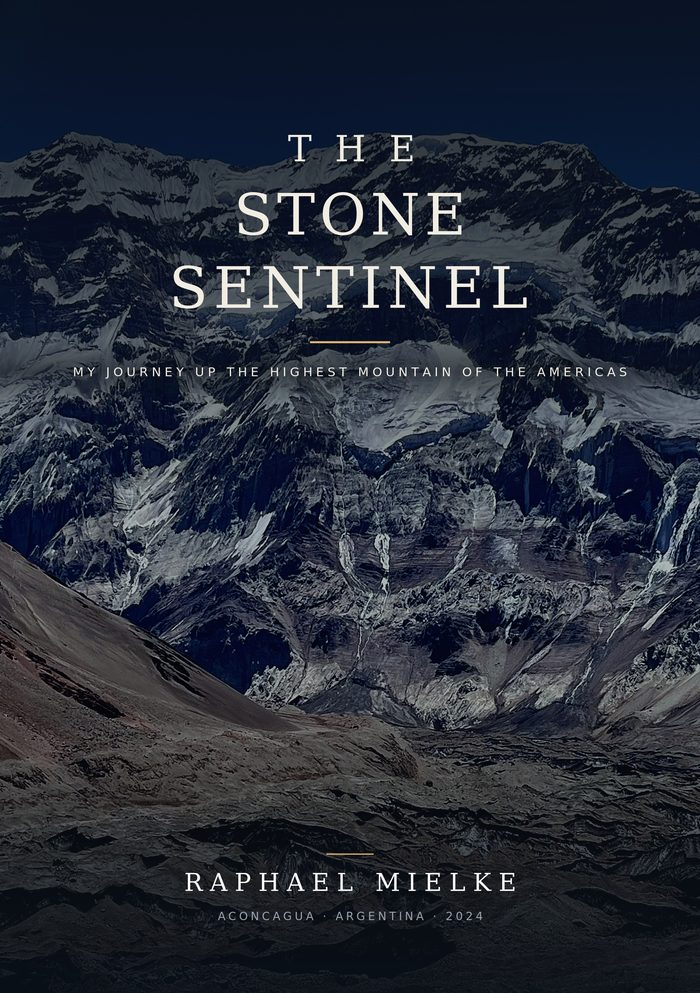
The full story behind these answers
"The Stone Sentinel" tells the expedition this knowledge comes from – three weeks of dust, storm, and thin air. Available as paperback and e-book.
Buy on Amazon